
Intermediate Spanish that gets you past the plateau
Beginner apps feel too easy. Native content feels impossible. Parrot delivers level-matched videos from real native speakers so every minute actually stretches your comprehension.

4.7 on the App Store810,959 learners
What intermediate Spanish learners actually need
Intermediate Spanish learners need content that sits just above their current level: videos from native speakers sequenced so they understand about 80% and stretch for the rest. Parrot, the Spanish learning app, delivers this. Its videos feature native speakers from around the world, including Mexico, Colombia, Argentina and Spain. Parrot pairs them with speaking practice and a personal dictionary reviewed with spaced repetition.
Difficulty adapts as comprehension grows, keeping learners in the zone where acquisition happens. Over 810,959 learners have used Parrot, and learners spend about 15 minutes a day.

Key takeaways: breaking the intermediate plateau
Five facts about moving past intermediate.
Parrot sequences videos so intermediate learners understand 80% and stretch for the remaining 20%, keeping content in the comprehensible-input zone.
Parrot's videos feature native speakers from Mexico, Colombia, Argentina, and Spain, exposing learners to multiple accents at natural speed.
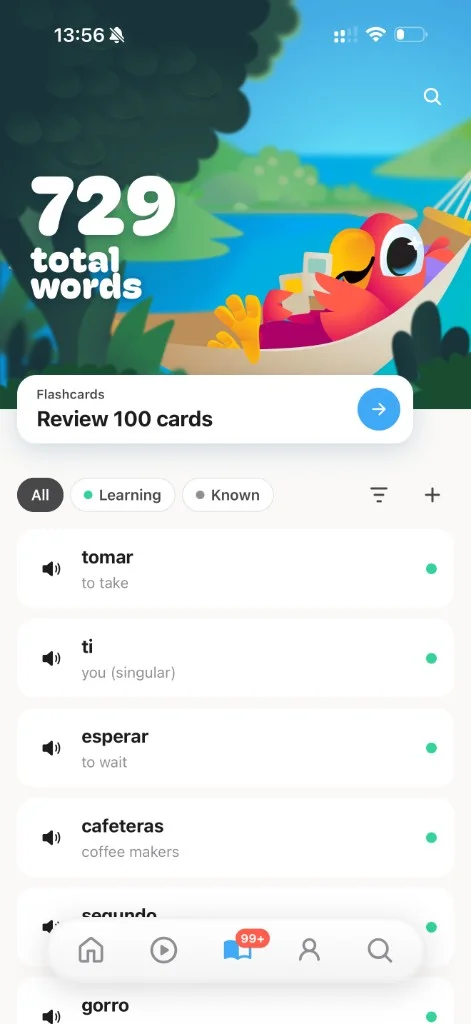
Tap any word in a Parrot video to translate it and save it to a personal dictionary reviewed with spaced repetition, so vocabulary sticks without grinding flashcards.
Parrot's pronunciation scoring gives feedback on speaking accuracy, turning output practice into measurable progress.
Difficulty adapts as comprehension improves, so the feed stays challenging without becoming overwhelming: solving the core problem that causes the intermediate plateau.
Why intermediate learners get stuck, and how to break through the plateau.
Content that stays too easy stops working when you reach the intermediate plateau
- Duolingo feels like busywork
- You've mastered the patterns it repeats
- Progress bars fill, comprehension stays flat
Native content feels impossible
- Spanish podcasts move too fast
- Subtitles become a crutch you can't drop
- Without them, comprehension drops to 30%
Nothing stretches you at the right level
- The gap between beginner and native is massive
- Most resources are too simple or too advanced
- No clear ladder up from where you are
Speaking practice still feels intimidating
- Comprehension is decent but output feels clunky
- Fear of fumbling keeps you silent
- Apps focus on input or output, not both

“My Colombian native boyfriend has told me how shocked he is at how well my Spanish is. I used Duolingo on and off for a few years and couldn't tell you a single thing I remember. In these past few days I've improved so much.”
Aloïs Hasselwander 🇩🇪
Why the intermediate plateau happens and how to break it
The plateau is a content problem, not a motivation problem
Intermediate learners hit a wall when beginner apps run out of appropriately leveled material and native content jumps to full speed with no scaffolding. The gap between beginner lessons and a Spanish podcast feels impossible because nothing sits in between.
Parrot solves this by sequencing videos so learners understand about 80% and stretch for the rest.
Parrot Back turns listening into speaking
Intermediate learners often freeze when asked to speak. Parrot Back speaking practice lets learners repeat what they hear after they understand it, so speaking feels natural instead of intimidating.
Comprehensible input operationalized for intermediates
Language is acquired when input sits slightly above current ability. The Parrot Method applies this: Parrot's feed sequences videos to your level, and difficulty adapts as comprehension grows, so learners stay challenged without being overwhelmed.
The result is a daily practice that feels like scrolling but compounds into real fluency.
Reading practice with video transcripts and inline translation
Intermediate learners need reading practice that connects to spoken Spanish, not isolated text exercises. Parrot displays video transcripts with inline translation, so learners read what they hear and see how written Spanish maps to native pronunciation.
Learners absorb grammar patterns and sentence structure naturally from context instead of memorizing rules.
 The Parrot Method
Listen, repeat, save, stay consistent.
A simple four-step cycle calibrated for intermediate learners, built on Krashen's comprehensible input research.
Listen and immerse
Short videos from native speakers at n+1 difficulty. Content sits just above your current level, never overwhelming.
Parrot back what you hear
Active repetition turns passive listening into output. Speaking feels natural because it's built on comprehension you already have.
Save words to your dictionary
Tap any word to add it. Spaced repetition surfaces it at the optimal moment for long-term memory.
Stay consistent
15 minutes a day compounds. The TikTok-style feed makes daily practice feel like scrolling, not studying.
Content that adapts to your level, every day.
Intermediate-specific content depth
- Higher vocab density, faster speech
- Idiomatic phrases beginner apps skip
- Every video pushes comprehension forward
n+1 sequencing keeps content stretching
- Feed adapts as you improve
- Always slightly above your level
- No artificial ceiling on difficulty
Skip what doesn't grab you
- TikTok-style swipe controls
- Engagement stays high
- You control the feed, not the algorithm
Input plus output in one app
- Massive listening immersion
- Cautious speech practice
- Both layers needed to break plateau
Personal dictionary + spaced repetition
- Save any word with one tap
- Words return at perfect intervals
- Long-term retention, not cramming
Multiple Spanish accents
- Mexico, Spain, Argentina, Colombia
- Train your ear for real variation
- Sound natural anywhere
Listening practice that bridges beginner and native content
Why podcasts and YouTube feel too hard
Intermediate learners are told to listen to Spanish podcasts or watch YouTube videos, but native content at full speed feels impossible when comprehension is far below 80%. The gap between understanding and guessing creates frustration, not fluency.
Tap any word to keep listening flow intact
Traditional Spanish listening practice breaks down when learners hit an unknown word and have to pause, search, and lose context. Parrot solves this by letting learners tap any word in a video to see the translation instantly, without leaving the feed.
Tapped words are saved to a personal dictionary and reviewed with spaced repetition, so vocabulary grows naturally from listening hours instead of grinding flashcards. Learners have tapped more than 20 million words.
Multiple accents, one feed
Real-world Spanish varies by region. Parrot includes videos from native speakers in Mexico, Colombia, Argentina, and Spain, so learners build comprehension across accents.
This exposure mirrors how native speakers actually talk, so a new accent is less of a surprise in a real conversation.
Speaking practice that builds confidence, not anxiety
Why speaking drills feel intimidating
Most intermediate learners know they need speaking practice but can freeze when asked to produce output on demand. Parrot builds speaking on top of comprehension, so confidence grows alongside understanding.
AI pronunciation scoring without the pressure
Parrot scores pronunciation with proprietary models built and trained in-house, giving learners feedback without the pressure of a live tutor or language partner. Scoring happens inside the listening experience, so learners get immediate correction while the audio is still fresh in their memory.
This approach offers low-pressure, self-paced practice. Learners can repeat a phrase as many times as needed.
Speaking is 20% of the method, listening is 80%
Parrot's method prioritizes input over output because comprehension must come first. The method is about 80% input and 20% output, which mirrors how children acquire their first language: years of listening before fluent output.
This ratio keeps speaking practice grounded in comprehension instead of forcing learners to produce sentences they do not yet understand. The result is speaking ability that feels natural because it is built on a foundation of real listening hours.
Learners can have a basic conversation in under 2 months
Learners who take it seriously can have a basic conversation in under 2 months. Everyone learns at a different pace and Parrot adapts to each learner.
This timeline reflects what happens when learners show up consistently and engage with both listening and speaking features.
Grammar and vocabulary that stick without drills
Vocabulary grows from context, not flashcards
Intermediate learners are told to memorize high-frequency word lists or grind through flashcard decks, but vocabulary learned in isolation does not transfer to real conversations. Words stick when they are encountered inside meaningful context, not as isolated translations.
Grammar insights when you need them, not before
Parrot includes optional grammar insights and verb conjugations for learners who want to understand the structure behind what they hear. Tap any verb to see its conjugations, or access grammar activities when a pattern feels unclear.
This approach keeps grammar secondary to comprehension. Learners acquire language through input first, then use grammar insights to clarify patterns they have already encountered in context. The result is understanding that feels intuitive instead of memorized.
Built for the level no one else targets.
Duolingo graduates
- Finished the tree, still can't converse
- Need real content that stretches you
- Tired of busywork drills
Returning learners
- Studied in school, lost it after
- Comprehension is partial, output is rusty
- Need a daily habit you'll keep
Busy professionals
- 15 minutes a day
- Fits commute, lunch, or bedtime
- Real progress without marathon study
Travel and immersion prep
- Real accents and slang, not textbook
- Confidence for real interactions
- Sound less like a tourist
The only app built for the intermediate plateau.
Learners who broke past the plateau.
Backed by Y Combinator. Trusted by 810,959+ learners.
“My Colombian native boyfriend has told me how shocked he is at how well my Spanish is. I used Duolingo on and off for a few years and couldn't tell you a single thing I remember. In these past few days I've improved so much.”
Aloïs Hasselwander 🇩🇪“I never thought scrolling could teach me a language. Parrot feels like TikTok but I'm actually learning. My friends are amazed I can hold a conversation in Spanish after just 2 months.”
 spanishlearner_22 🇬🇧
“As someone who has always been interested in learning different languages I've struggled to stay consistent with apps like Duolingo. Parrot keeps me coming back every single day.”
 Amir 🇺🇸
“The short video format is genius. I learn during my commute, during lunch breaks, before bed. It never feels like studying. I'm addicted in the best way possible.”
 linguafranca 🇺🇸
“Parrot gets it. No boring grammar drills, no guilt-tripping streaks. Just real Spanish content that sticks in your brain. I've learned more in 3 weeks than a full semester of college Spanish.”
 worldtraveler99 🇺🇸
“I have been using this app for a while now and FINALLY I can express myself to my Mexican MEJOR AMIGA and I can communicate easier with her family too! YOU GUYS made my language learning journey so much easier!”
 thatcutegirlyoumetonce 🇺🇸
Your first 30 days with Parrot.
A clear roadmap so you know exactly what to do as an intermediate learner.
Week 1: Find your level and build the habit
Onboarding matches your level. Spend 15 minutes a day on the feed. Skip what doesn't grab you.
Week 2: Add output practice
Begin parroting back what you hear. Mimic pronunciation and rhythm. Repetition compounds fast.
Week 3: Build your personal dictionary
Tap unknown words to save them. Review for a few minutes daily. Vocabulary grows without grinding flashcards.
Week 4 and beyond: Let the feed adapt
As comprehension improves, the feed gets harder. Keep showing up daily: fluency compounds.
Moving from intermediate to advanced Spanish
B1 to B2 is about exposure hours, not study hours
The jump from B1 to B2 requires a lot of exposure to content that sits just above current comprehension. Most learners stall because they try to study their way to B2 with grammar drills instead of immersing themselves in native input.
Parrot solves this by making exposure hours feel like scrolling. The short-form feed delivers videos from native speakers, so learners log comprehension time without scheduling dedicated study sessions. Progress happens through consistency, not intensity.
Content that adapts as you improve
B1 learners need content that stretches them without overwhelming them, and B2 learners need content that challenges them without feeling impossible. Parrot's feed adapts automatically as comprehension grows, so learners stay in the acquisition zone without manually searching for harder material.
This adaptive sequencing is what helps break the plateau. Learners are less likely to outgrow the feed because difficulty adapts as they get better, all the way to advanced Spanish. The result is continuous progress instead of stagnation.
Daily consistency compounds faster than weekly bursts
Parrot's short-form format makes daily practice effortless. Learners scroll during commutes, lunch breaks, or before bed, so consistency becomes a habit instead of a chore. The feed is designed to feel like entertainment, not studying.
Related pages
Common questions about intermediate Spanish learning.
What is the intermediate plateau and why does it happen?
The intermediate plateau is the point where vocabulary and comprehension stop growing because content no longer stretches you. Beginner apps feel too easy, native content too hard. Parrot solves this with intermediate-specific n+1 content that adapts as you improve.
How is Parrot different from FluentU or Yabla?
FluentU and Yabla focus on long-form video and passive listening. Parrot delivers short-form content in a TikTok-style feed paired with output practice, with automatic sequencing instead of manual content selection.
How does Parrot know what level I'm at?
Parrot's onboarding assessment matches content to your current comprehension. As you progress, the feed adapts using n+1 sequencing, so content always sits just above where you are. No manual leveling required.
That works whether you want to relearn Spanish from school or are starting from zero with Spanish for beginners.
Can I skip videos I don't like?
Yes. Swipe to the next video anytime, just like TikTok. Engagement is critical at intermediate level. Boredom kills consistency, so Parrot lets you control the feed and find content you actually enjoy.
How much time do I need each day?
Fifteen minutes a day is enough to make real progress. Fluency comes from cumulative exposure hours, not intensity, so consistency matters more than long study sessions.
How long does it take to break the plateau?
Most learners see noticeable improvement in comprehension and speaking confidence within 3 to 6 months of daily practice. The TikTok-style feed keeps engagement high so daily practice feels like scrolling, not studying.
Does Parrot include speaking practice?
Yes. Parrot pairs immersion with output practice. After watching videos, you parrot back what you hear to build speaking confidence and sharpen pronunciation.
Is Parrot better than Duolingo for intermediate learners?
Duolingo is designed for beginners. Once you've maxed out the lessons, progress stalls because the content doesn't stretch you anymore. Parrot is built specifically for intermediate learners, with native-speaker videos that adapt to your level.
What is the difference between B1 and B2 Spanish proficiency?
B1 learners can handle familiar topics and simple conversations but struggle with native-speed speech and complex grammar. B2 learners understand most native content, participate in detailed discussions, and express opinions with nuance.
The jump from B1 to B2 takes a lot of comprehensible input at the right level, which is exactly what Parrot delivers through adaptive video sequencing.
What are the best listening resources for intermediate learners?
Podcasts and YouTube work for some learners, but native content can feel too fast at the intermediate level. Parrot delivers short videos from native speakers in Mexico, Colombia, Argentina, and Spain, sequenced so learners understand about 80% and stretch for the rest.
Tap any word to translate it instantly, so listening flow stays intact and vocabulary grows naturally from context.
How does Parrot score pronunciation?
Parrot scores pronunciation with proprietary models built and trained in-house, giving feedback inside the listening experience. This lets learners hear native speech, repeat it, and check their pronunciation, all without leaving the video feed.
What grammar topics should intermediate Spanish learners focus on?
Grammar is best learned in context, not through isolated drills. Parrot lets learners tap any verb to see conjugations and access optional grammar insights when a pattern feels unclear.
Vocabulary and grammar stick faster when encountered inside native-speaker sentences, so learners remember not just the rule but how it is used in real speech. This keeps grammar secondary to comprehension, which is how language is actually acquired.
Break the plateau. Build real fluency.
Join 810,959+ learners using Parrot to finally move past intermediate. Start with a 7-day free trial.