
Learn Spanish Vocabulary That Actually Sticks
Tap any word in a native-speaker video to save it. Review with Tinder-swipe flashcards. Spaced repetition does the rest: auto-built, contextualized, retained.

4.7 on the App Store810,959 learners
How Parrot builds Spanish vocabulary
Parrot pairs native-speaker video with spaced repetition so you learn Spanish vocabulary the way your brain acquires language. Learners have tapped over 20 million words, and every word you tap is saved to a personal dictionary reviewed with spaced repetition.
Videos feature native speakers from Mexico, Colombia, Argentina, and Spain, so every word is anchored to real conversational context instead of isolated drills. Over 810,959 learners have used Parrot, on iOS, Android, and the web.

Key takeaways
Context before repetition builds retention
Parrot pairs comprehensible input with spaced repetition, so you encounter words in native-speaker video before reviewing them. Your brain anchors meaning to real conversational moments, not abstract lists.
Tapped words go straight to your dictionary
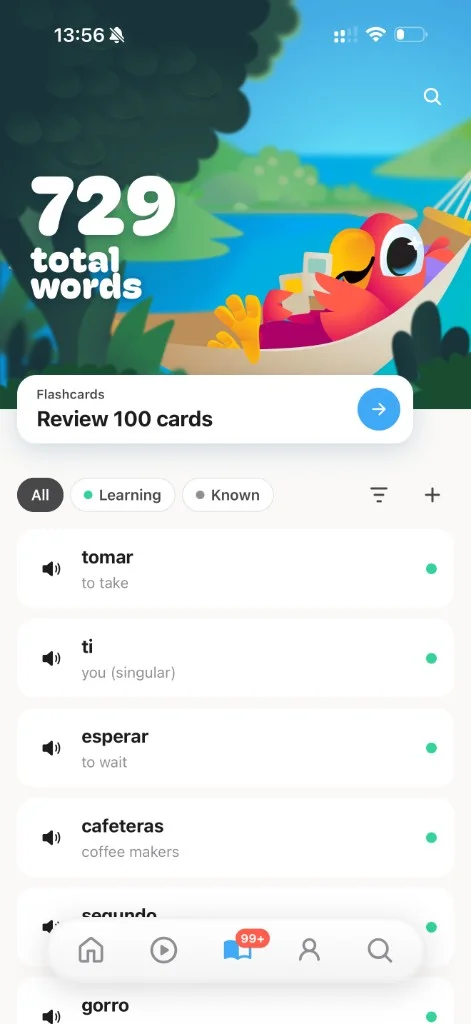
Every word you tap is saved to your personal dictionary, which is reviewed with spaced repetition, so there is no manual deck-building. You save words during immersion and review them later.
Clickable words let you control what you learn
Tap any word in a video transcript to see its translation and save it to your personal dictionary. You decide which words matter to you, building a vocabulary list that reflects your actual learning path rather than a pre-set curriculum.
Native video exposure mirrors real-world speech
Videos feature native speakers from Mexico, Colombia, Argentina, and Spain, delivering vocabulary at natural speed and rhythm. You hear how words sound in real conversations, not scripted textbook lessons.
Daily practice fits into scroll habits
Parrot turns passive screen time into active vocabulary practice without requiring long study blocks.
The retention problem, diagnosed.
Flashcards without context feel disconnected, because you miss the real meaning behind each word
- "Gato = cat" doesn't show real usage
- Brain can't link card to spoken context
- Isolated words rarely transfer to conversation
Pre-made lists don't reflect your journey
- Generic top-500 lists waste your time
- Missing words relevant to your interests
- Disconnect kills motivation fast
Anki works but the setup is exhausting
- Hours building and maintaining decks
- Most learners quit before seeing results
- SRS shouldn't require a second job
Forgetting happens when timing is off
- Cramming the night before fades in days
- Reviewing too often wastes time
- Retention requires precision timing

“My Colombian native boyfriend has told me how shocked he is at how well my Spanish is. I used Duolingo on and off for a few years and couldn't tell you a single thing I remember. In these past few days I've improved so much.”
Aloïs Hasselwander 🇩🇪
 Auto-built flashcards from real Spanish
The vocabulary loop: encounter, save, review, retain.
Four steps that turn passive watching into long-term vocabulary, with zero deck-building.
Encounter words in native-speaker video
Watch real Spanish. Tap any word in the transcript for an instant translation. First encounter happens in context.
Save automatically to your dictionary
Every tapped word is saved. No manual deck-building, no spreadsheets. Your dictionary grows organically.
Review with Tinder-swipe flashcards
Swipe right if you remember, left if you need to see it again. Seconds per word: easy to fit anywhere.
Spaced repetition locks words in long-term memory
Words you struggle with reappear sooner. Words you know space out over days or weeks. The same SRS med students use.
Daily study routine for learning vocabulary
Start small and let your dictionary grow
Tap only the words you really want to learn, so your review queue stays manageable. Saved words go to your personal dictionary and are reviewed with spaced repetition.
Learners spend about 15 minutes a day
Most learners spend about 15 minutes a day on Parrot, though power users go well past an hour. This daily habit fits into commutes, lunch breaks, or before bed without requiring long study blocks.
Short sessions make it easier to maintain consistency.
Scale up as your dictionary grows
As your personal dictionary grows, spaced repetition keeps your review focused on the words that need it.
Features that make Spanish vocabulary stick.
Tap-to-translate in transcripts
- Instant translation without pausing
- Stay immersed in the content
- Build your dictionary on the fly
Auto-built flashcard decks
- Every saved word becomes a card
- Parrot handles formatting and scheduling
- Zero setup, zero maintenance
Tinder-swipe mobile interface
- Reviews feel like scrolling, not studying
- Intuitive and addictive
- Daily review becomes a habit
Spaced repetition scheduling
- Optimal timing for every word
- Struggling words come back sooner
- Known words space out automatically
Personal dictionary that grows
- Every word you've ever saved
- Definitions and example sentences
- Tracks your review history
Context from real native Spanish
- Words come from real conversations
- Meaning tied to usage
- Vocabulary you'll actually hear
Essential vocabulary categories for beginners
Greetings and everyday phrases
Parrot's native-speaker videos cover greetings like 'hola,' 'buenos días,' and 'cómo estás' in real conversational contexts, so you hear how native speakers actually use these phrases. Tap any greeting in the transcript to save it to your personal dictionary and review it later.
Everyday phrases like 'por favor,' 'gracias,' and 'de nada' appear frequently in Parrot's video feed, giving you repeated exposure to the polite expressions you need for basic interactions.
Question words for building conversations
Question words like 'qué,' 'dónde,' 'cuándo,' 'cómo,' and 'por qué' are essential for asking and understanding questions. Parrot's videos feature native speakers using these words in real questions, so you hear how they sound and function in natural speech.
Save question words as you encounter them in video transcripts, then review them with spaced repetition flashcards to lock them into long-term memory.
Core verbs for everyday actions
Verbs like 'ser,' 'estar,' 'tener,' 'hacer,' 'ir,' and 'ver' form the foundation of sentences. Parrot shows verb conjugations and grammar insights when you tap any verb in a video, so you understand how the word changes in different contexts.
Videos show these verbs in action, whether someone is describing their day, asking for directions, or talking about their plans. You see verbs the way native speakers use them, not as isolated conjugation tables.
Numbers, colors, and descriptive words
Numbers, colors, and common adjectives like 'grande,' 'pequeño,' 'bueno,' and 'malo' appear across Parrot's video library in everyday contexts. You might hear a speaker describe their favorite color, count items, or talk about the weather.
These descriptive words build your ability to understand and describe the world around you.
Food, family, and daily life topics
Parrot's videos are about everyday life, so they include work situations and health situations alongside topics like food, family, and daily routines. Words like 'comida,' 'familia,' 'trabajo,' and 'casa' appear naturally as speakers talk about their lives.
This thematic exposure helps you build vocabulary clusters around topics you'll use in real conversations, and the context makes each word easier to remember than a pre-made list.
Spain Spanish vs. Latin American Spanish: which to learn first
Latin American Spanish covers more speakers and regions
Latin American Spanish is spoken across Mexico, Central America, South America, and the Caribbean, making it the most widely used variety by population.
Parrot's video library features native speakers from Mexico, Colombia, and Argentina, so you hear the vocabulary and pronunciation used by the majority of speakers worldwide.
If you plan to travel, work, or communicate in the Americas, starting with Latin American Spanish gives you the broadest foundation.
Spain Spanish uses distinct pronunciation and vocabulary
Spain Spanish (Castilian) includes pronunciation features like the 'th' sound for 'c' and 'z,' and vocabulary differences like 'ordenador' instead of 'computadora.' Parrot's videos from Spain let you hear these distinctions in real conversational contexts, so you understand how the variety differs from Latin American Spanish.
If you plan to live, study, or work in Spain, exposure to Castilian pronunciation and vocabulary from the start will serve you better.
More granular accent options are coming soon
Parrot's videos currently mix Latin American Spanish and Spain Spanish, giving you exposure to multiple accents as you learn. More granular accent options are coming soon.
Until then, you can tap any word in a video transcript to save it, regardless of the speaker's accent, and build a personal dictionary that reflects the Spanish you actually want to use.
Start with the variety you'll use most
Latin American Spanish suits you if you'll communicate in the Americas, and Spain Spanish if you're focused on Spain. Parrot's videos mix both varieties, so you hear them in one app, and difficulty adapts as your comprehension grows.
When to transition from flashcards to comprehensible input
Parrot uses comprehensible input from day one
Parrot's video feed is built on comprehensible input theory: we acquire language when we understand messages, not when we memorize rules.
This means you start watching native-speaker videos from your first session, even as a beginner, and tap unfamiliar words for instant translation. Early exposure to real speech helps you recognize words in context before you've memorized them in isolation.
The Parrot Method is 80% input, 20% output
The Parrot Method is 80% input (listening, reading) and 20% output (speaking), so most of your time is spent watching native videos and reading transcripts.
That makes your vocabulary work Spanish listening practice at the same time.
Parrot combines both methods from day one
Parrot integrates comprehensible input and spaced repetition from your first session, so you don't have to choose between flashcards and native content. Watch videos to encounter new words in context, tap to save them, then review them with spaced repetition.
This dual approach works at any level, and it eliminates the need to decide when to transition from one method to another.
Track your progress with your personal dictionary
Parrot's personal dictionary tracks every word you save and review, so you can see your vocabulary grow from beginner to intermediate.
Knowing where you stand helps you adjust your routine: more flashcard reviews if you're building foundational vocabulary, or more video immersion if you're ready to prioritize comprehensible input.
Where Parrot's vocabulary system shines.
Travel and immersion prep
- Build vocab from real travel content
- Save words you'll actually use
- Arrive ready, not fumbling
Breaking intermediate plateaus
- Add high-frequency vocab in context
- Fill gaps textbooks miss
- Comprehension expands fast
Systematic learners who hate Anki setup
- SRS power, zero deck-building
- All retention, none of the labor
- Best of both worlds
Busy learners on tight schedules
- 3-5 minute review sessions
- Commute, lunch, waiting room
- Small daily reps compound fast
Why Parrot works when Anki and Quizlet don't.
How Parrot compares to Anki, Memrise, and Clozemaster
| App | Setup | Where words come from | Spaced repetition |
|---|---|---|---|
| Parrot | None: tapped words save to your personal dictionary | Native-speaker videos | Yes |
| Anki | You build decks and card templates yourself | Cards you make | Yes |
| Memrise | Official courses and wordlists | Course words with short native-speaker clips (full set is Pro-only) | Yes, personalised review plans |
| Clozemaster | See clozemaster.com | Cloze-deletion sentence drills | See clozemaster.com |
Parrot vs. Anki:auto-built decks vs. manual setup
Anki is a flashcard app that asks you to build decks and card templates yourself. Parrot saves the words you tap in native-speaker videos to a personal dictionary reviewed with spaced repetition, so there is no deck setup.
Parrot vs. Memrise:native video context vs. pre-made lists
Memrise offers per-word native clips and spaced review. Parrot lets you save words from real native-speaker videos as you encounter them, so your personal dictionary grows around the content you actually watch.
Every word in your personal dictionary comes from a video you watched, which ties it to a real conversational moment. Read the full Memrise alternative comparison.
Parrot vs. Clozemaster:comprehensible input vs. sentence drills
Clozemaster uses cloze-deletion sentence drills to teach vocabulary in context. Parrot delivers vocabulary through native-speaker videos that show how words are used in natural speech.
If you want to understand real conversations, Parrot's video feed mirrors how native speakers actually talk, and the tap-to-translate feature lets you save words without interrupting the flow.
Parrot's library has tens of thousands of videos
Parrot's library has tens of thousands of videos featuring native speakers from around the world, including Mexico, Colombia, Argentina, and Spain. Videos include transcripts with inline translation, which doubles as Spanish reading practice.
Every piece of content is screened by a person.
Personal dictionary and spaced repetition: how it works
Tap any word in a video to save it
Watch a native-speaker video in Parrot and tap any word in the transcript for an instant translation. That word is saved to your personal dictionary automatically, with no manual card creation or deck setup required.
Review saved words with spaced repetition
Your saved words come back for review with spaced repetition, so review sessions focus on the words that need it. Reviews are short enough to fit into a few spare minutes.
Say new words out loud
Parrot Back has you repeat phrases out loud after native-speaker clips, and the AI Spanish Tutor's speaking activities score your pronunciation with proprietary models built and trained in-house.
Trusted by 810,959+ Spanish learners.
Backed by Y Combinator. Loved on the App Store.
“My Colombian native boyfriend has told me how shocked he is at how well my Spanish is. I used Duolingo on and off for a few years and couldn't tell you a single thing I remember. In these past few days I've improved so much.”
Aloïs Hasselwander 🇩🇪“As someone who has always been interested in learning different languages I've struggled to stay consistent with apps like Duolingo. Parrot keeps me coming back every single day.”
 Amir 🇺🇸
“Parrot gets it. No boring grammar drills, no guilt-tripping streaks. Just real Spanish content that sticks in your brain. I've learned more in 3 weeks than a full semester of college Spanish.”
 worldtraveler99 🇺🇸
“The short video format is genius. I learn during my commute, during lunch breaks, before bed. It never feels like studying. I'm addicted in the best way possible.”
 linguafranca 🇺🇸
“I have been using this app for a while now and FINALLY I can express myself to my Mexican MEJOR AMIGA and I can communicate easier with her family too! YOU GUYS made my language learning journey so much easier!”
 thatcutegirlyoumetonce 🇺🇸
“I never thought scrolling could teach me a language. Parrot feels like TikTok but I'm actually learning. My friends are amazed I can hold a conversation in Spanish after just 2 months.”
 spanishlearner_22 🇬🇧
Start building Spanish vocabulary in minutes.
Most learners notice comprehension improvements within the first week.
Download the app, choose your level
iOS, Android, and web. Comprehensible input matches your starting point on day one.
Watch your first video, save a word
Tap any word in the transcript. Your first flashcard is created automatically.
Review saved words daily
3-5 minutes of Tinder-swipe flashcards. Spaced repetition handles the schedule.
Watch your dictionary grow
Personal dictionary tracks every word and review. Hundreds of retained words within weeks.
Your questions about learning Spanish vocabulary with Parrot.
How does Parrot's spaced repetition system work?
Spaced repetition schedules your reviews based on how well you remember each word. Struggle with a word and it appears sooner. Remember it easily and the next review spaces out over days or weeks. The timing is automatic and optimized for long-term retention, the same principles med students use.
Do I have to build my own flashcard decks?
No. Every word you tap to translate in a video is saved to your personal dictionary and becomes a flashcard automatically. Parrot handles all the formatting, scheduling, and organization. Your only job is to watch videos and swipe through reviews.
How many Spanish words can I learn with Parrot?
There's no limit. Your dictionary grows as you watch more videos. Most learners save 10 to 20 words per session and review daily. Over weeks this compounds into hundreds of retained words.
Is Parrot better than Anki for vocabulary?
Parrot gives you the retention power of Anki's spaced repetition without the manual deck-building. Your flashcards are auto-generated from native-speaker video, so they're always contextualized. If you want SRS without the setup friction, Parrot is the better choice.
Can I use Parrot alongside other Spanish tools?
Absolutely. Many learners use Parrot for vocabulary and immersion while supplementing with grammar resources or conversation practice. The personal dictionary works independently and integrates into any study routine.
How much time do I need for vocabulary reviews?
Most learners spend 3 to 5 minutes a day on Tinder-swipe flashcard reviews. Because Parrot uses spaced repetition, you only review words that are due, keeping sessions short.
Are the words I learn suitable for my level?
Yes. Parrot's feed adjusts to your level so vocabulary is always comprehensible. You'll encounter words slightly above your current ability, the optimal zone for acquisition (n+1 comprehensible input).
What makes Parrot different from Duolingo or Memrise?
Duolingo and Memrise use pre-made word lists and gamified drills. Parrot's vocabulary comes from real native-speaker videos so you learn words in context first, then reinforce with spaced repetition.
For a wider comparison, see our guide to alternatives to Duolingo.
How many new Spanish words should I learn per day?
Tap only the words you want to learn. Words you tap during immersion are saved to your personal dictionary and reviewed with spaced repetition, so your daily intake reflects what you actually encountered in real content rather than a pre-set list.
How does Parrot's personalized sequencing adapt to my level?
Parrot sequences videos so you understand about 80% and stretch for the rest, and difficulty adapts as your comprehension grows. Your level is set from your onboarding answers plus a short placement test (5 minutes or less).
Should I learn Spain Spanish or Latin American Spanish vocabulary first?
Choose the variety that matches your goals: Latin American Spanish if you'll communicate in the Americas, or Spain Spanish if you're focused on Spain. Parrot's video library features native speakers from Mexico, Colombia, Argentina, and Spain, so you encounter both Latin American and Castilian Spanish as you watch.
You can tap any word in a video transcript to save it, regardless of the speaker's accent, and build a personal dictionary that reflects the Spanish you actually want to use.
How does Parrot compare to LingQ for vocabulary learning?
LingQ's free plan caps saved words at 20 (lingq.com, checked November 2026). Parrot saves the words you tap to a personal dictionary reviewed with spaced repetition, with full access during your 7-day free trial and with a Premium subscription.
Build the Spanish vocabulary that finally sticks.
Join 810,959+ learners using Parrot's auto-built, context-first vocabulary system. Start with a 7-day free trial.